International Security Focus on Nigeria: Macron Pledges Support to Tinubu as US Congressional Delegation Arrives for Fact-Finding Mission.

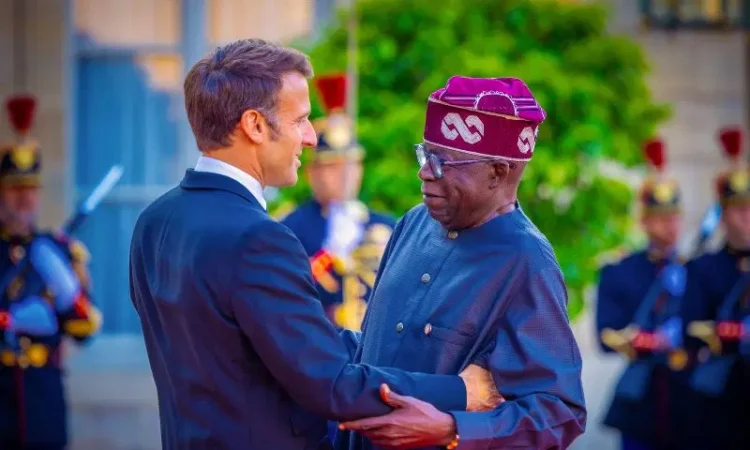
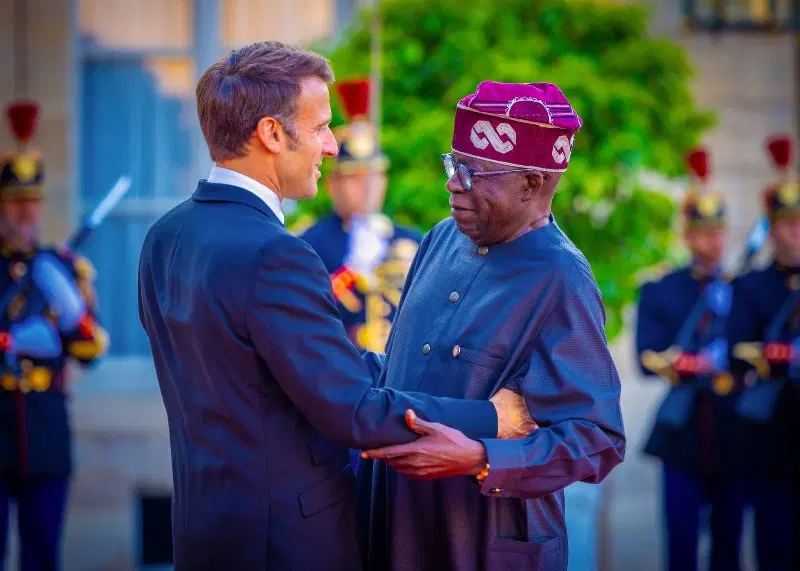
On Sunday, President Bola Tinubu and French President Emmanuel Macron held talks to discuss Nigeria’s security crisis and areas for bilateral cooperation. This high-level call occurred while a US delegation met in Abuja with National Security Adviser Nuhu Ribadu to address concerns over Christian persecution and killings in the country. Following the call, Macron posted on X, affirming France’s intent to strengthen its partnership with Nigerian authorities and conveying the country’s “solidarity in the face of the various security challenges, particularly the terrorist threat in the North.”
In response to President Tinubu’s request, Macron committed to increasing French engagement: “we will strengthen our partnership with the authorities and our support for the affected populations.” He also issued a call for broader international participation, declaring, “We call on all our partners to step up their engagement. No one can remain a spectator.” The French President confirmed that his government will work directly with the Federal Government to deliver the requested support to populations impacted by the security crisis.
Macron’s statement of solidarity follows a recent wave of gun attacks and kidnappings across the northern region, which have drawn international condemnation. The French leader’s call comes just days after President Tinubu swore in the new Minister of Defence, Gen. Christopher Musa (retd.), with a charge to deliver quick results. On November 26, Tinubu declared a nationwide security emergency, ordering the military and intelligence services to expand recruitment and deploy thousands of additional personnel, while prioritizing the safety of schools, farms, and places of worship. The conversation with Macron is set against broader international scrutiny, especially from US President Donald Trump, who recently re-designated Nigeria as a Country of Particular Concern for religious freedom violations and threatened military intervention, citing an alleged genocide against Christians. The Federal Government has consistently rejected claims of Christian persecution, maintaining that insecurity in Nigeria affects citizens of all religions.
The worsening security situation has prompted the Federal Government to seek diplomatic aid from the international community. This outreach included National Security Adviser (NSA) Nuhu Ribadu’s visit to Washington, D.C., where he was hosted by US Secretary of War Pete Hegseth at the Pentagon on November 20 to discuss strategies for solving the crisis. That same day, the US House Subcommittee on Africa held a public hearing to examine the re-designation of Nigeria as a Country of Particular Concern (CPC), with lawmakers also holding an open briefing to assess the designation’s implications. Last Tuesday, House Republicans issued warnings about rising religious violence during a joint briefing convened at the instance of President Trump. Confirming the continuation of these engagements, the NSA announced he hosted a US Congressional delegation in Abuja, describing the visit as a “fact-finding mission to Nigeria, following our earlier engagements in Washington, DC, on shared security priorities.”
Ribadu confirmed that the US Congressional delegation was accompanied by the US Ambassador to Nigeria, Richard Mills, a development he said “reflected the importance both nations attach to this engagement.” The NSA stated that discussions focused on “counter-terrorism cooperation, regional stability,” and strategies to “strengthen the strategic security partnership between Nigeria and the United States.” Ribadu expressed optimism, saying, “I’m optimistic this engagement will deepen trust, collaboration, and shared commitment to peace and security.”
Separately, US House of Representatives member Riley Moore announced the conclusion of his trip to Nigeria on Sunday via a post on X. Moore, who stated he came “in the name of the Lord and on behalf of the American people,” said he was “Just ending a very productive visit to Nigeria and rounds of meetings.” While promising more details, Moore did not provide further information on the purpose of his visit or the officials he met.
A US delegation, including the Assistant Secretary of State and Ambassador Richard Mills, visited Benue State on Saturday, meeting with Governor Hyacinth Alia, the local Catholic Bishops, and the Tor Tiv. While the purpose was officially undisclosed, it is widely reported to be linked to the ongoing US scrutiny and allegations of religious persecution in Nigeria—a topic previously raised by Bishop Wilfred Anagbe before the US Congress.
Governor Alia, in contrast to the Tor Tiv’s previous condemnation of the crisis as “genocide,” recently denied these claims, asserting that as a Reverend Father in governance, he could confirm there is “no religious, ethnic, racial, national or state genocide” in Benue. Meanwhile, Iorbee Ihagh, leader of the state’s key socio-cultural groups, criticized the state government’s denial and its failure to show the US team the IDP camps and sites of major attacks, like Yelwata, which was previously condemned as “genocide” by the Tor Tiv.
Iorbee Ihagh, leader of the three major socio-cultural groups in Benue, accused the state government of “playing politics with the killings.” He argued that the US visit was an “ample opportunity to take the US team to Yelwata” and to the various IDP camps for a direct assessment. On a separate, positive note, the Federal Government has reportedly secured the release of 100 schoolchildren abducted from St. Mary’s Catholic School in Papiri, Niger State. However, authorities have not yet officially confirmed the release of the pupils as of the time of the report.
The reported release follows the NSA’s visit to the school a week prior, where he delivered President Tinubu’s message of hope and assured parents and the proprietor that the children would be rescued. Ribadu emphasized that rescue efforts were progressing and security deployment had been ramped up, stating: “They are going to come back. I give you that assurance.” The mass abduction took place on November 21, 2025, when gunmen attacked the school dormitories in the remote Papiri community and abducted 315 individuals, comprising 303 students and 12 teachers.
Although 50 pupils escaped and were reunited with their families in the immediate aftermath, 265 individuals—including 253 children and all 12 teachers—remained in captivity. In response, the Federal Government launched an extensive rescue mission, deploying aerial surveillance across the forests and riverine terrain of parts of Kwara, Kebbi, and Niger States. As a broader security measure, the authorities also ordered the shut down of all schools in Niger State and many federal unity colleges across several northern states.